Leave Your Message

How to Choose LED Curing Lamps for Global Sourcing?

Choosing Led Curing Lamps for global sourcing requires more than comparing prices and advertised power. A lamp that looks efficient on a supplier’s website may perform differently in a real production line. Wavelength, irradiance, curing distance, heat control, and operating life can change the final result. Small differences matter.

Experienced buyers often begin with the application, not the catalog. Ask which adhesive, coating, resin, or ink must be cured. Confirm the required wavelength range, exposure time, and light intensity. Request test data from calibrated instruments. A simple sample trial can reveal uneven curing, shadowed areas, or excessive surface heat. It is practical evidence.

Supplier evaluation also deserves close attention. Review technical drawings, electrical specifications, warranty terms, replacement policies, and quality records. Check whether the manufacturer can provide consistent batches. Independent reports and recognized compliance documentation add confidence, but documents should never replace physical testing. Specifications alone can mislead. That lesson is easy to forget.

Global purchasing introduces additional details. Packaging must protect lenses and cables during long transportation. Voltage, plug design, installation support, and spare-part availability should match the destination market. Confirm communication procedures before placing a large order. A supplier’s response to difficult questions can be as revealing as its product samples.

There is no universal best lamp. The strongest choice balances curing performance, safety, serviceability, and total ownership cost. Build a comparison sheet, test realistic materials, and record every result. A careful decision may take longer. It usually prevents expensive rework later.
How to Choose LED Curing Lamps for Global Sourcing?

Define the Application and Curing Requirements

Before sourcing an LED curing lamp, define exactly what must be cured. Adhesives, coatings, inks, and sealants can require different light conditions. Record the substrate, material thickness, surface color, and curing area. A clear adhesive on glass behaves differently from a filled resin on metal. Small details matter. Also identify the production speed and available installation space. A lamp that works in a laboratory may fail beside a fast-moving assembly line.

Measure the required wavelength, irradiance, and energy dose from the material supplier’s technical data. Wavelength compatibility comes first. Higher intensity cannot always compensate for an incorrect wavelength. Check the required cure depth, exposure time, and acceptable surface hardness. For shaded joints, consider whether light can reach the entire bond line. Some designs need multiple lamp angles or a different curing method. Heat-sensitive plastics also require temperature limits and monitoring.

Use a test piece that matches real production conditions. Measure light output at the actual working distance, not only at the lamp window. Verify curing results with practical checks, such as hardness, adhesion, and visual inspection. Keep records for every trial. This supports consistent global purchasing and later quality audits. A specification can look complete yet miss an important variable. Recheck it after testing. The first assumption may be wrong. Suppliers should provide measurable data, safety documentation, and calibration information, but buyers still need independent verification before approval.

How to Choose LED Curing Lamps for Global Sourcing?

Define the application and curing requirements before comparing lamp specifications.

How to use this chart: The ranges show typical target irradiance levels used for different UV-curing applications. Confirm the required wavelength, irradiance, exposure time, and dose with the material supplier. Common LED peaks include 365 nm, 385 nm, 395 nm, and 405 nm, but the correct wavelength must match the photoinitiator. Curing dose is calculated as irradiance multiplied by exposure time.

Compare LED Curing Lamp Types and Key Specifications

How to Choose LED Curing Lamps for Global Sourcing?

Compare LED Curing Lamp Types and Key Specifications

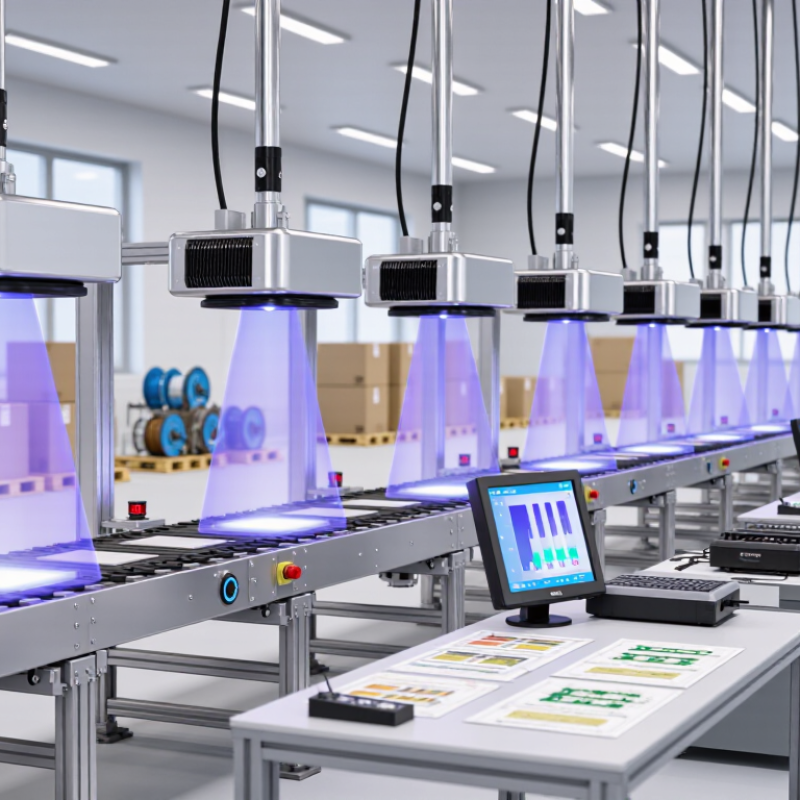
Choosing LED curing lamps requires more than comparing wattage. The lamp type must match the adhesive, coating, or resin process. Spot lamps suit small components and focused repairs. Flood lamps cover wider surfaces with less precise energy. Conveyor systems support repeatable production, but they require careful alignment and speed control.

Wavelength is a critical specification. Many materials respond to narrow ultraviolet ranges, often near 365, 385, 395, or 405 nanometres. Always confirm the material’s curing response before purchasing.

Irradiance shows the power reaching the surface, while dose combines power with exposure time. A high reading at the lamp window may not represent the workpiece. Measure at the actual curing distance.

Uniformity matters greatly. Uneven intensity can leave soft edges or brittle centers. Ask suppliers for irradiance maps, test methods, and calibrated measurement records.

Cooling design also deserves attention. Air cooling may fit compact operations, while liquid cooling suits continuous, high-output work. I have seen buyers ignore heat transfer and later reduce curing speed. That was avoidable.

Check control compatibility, operating voltage, connector standards, safety documentation, and spare-part access across markets. A small mismatch can delay installation. Request a sample test with your real material, thickness, distance, and production cycle. Supplier claims help, but measured results are stronger.

Evaluate Wavelength, Intensity, Coverage, and Cooling

How to Choose LED Curing Lamps for Global Sourcing?

When sourcing LED curing lamps globally, wavelength should match the material’s photoinitiator response. Common options include 365, 385, 395, and 405 nanometers. A small mismatch can leave the surface tacky or weaken adhesion. Do not trust labels alone. Request spectral test data from an independent laboratory, when possible. I once compared two lamps with identical wavelength claims, but their actual output differed noticeably.

Intensity determines curing speed and depth. Ask suppliers for irradiance values in mW/cm², measured at a stated working distance. Distance matters. Measure it.

Coverage is equally important for production consistency. A narrow beam may cure one small area quickly, while edges remain soft. Check the effective curing field, not only the LED array size. Use test pieces that match your real product, including curved or recessed sections. Overlapping exposure zones can create uneven results, a problem I underestimated during an early evaluation.

Cooling affects output stability and service life. Passive cooling may suit short cycles, but continuous production often needs controlled airflow or stronger heat dissipation. Monitor housing temperature after repeated cycles. Ask for thermal protection details, fan replacement access, and performance data after extended operation. Some suppliers provide impressive peak figures, yet omit output decline during heat buildup. That omission deserves questions. Also verify input voltage, calibration records, spare-part availability, and technical support for your destination market.

How to Choose LED Curing Lamps for Global Sourcing? - Evaluate Wavelength, Intensity, Coverage, and Cooling

Application Profile Recommended Peak Wavelength Typical Spectral Bandwidth
(FWHM)
Typical Irradiance
at Working Distance
Recommended Coverage Curing Uniformity Target Cooling Requirement Key Sourcing Check
UV Adhesives and Small Assemblies 365–405 nm, matched to adhesive photoinitiator Approximately 10–15 nm 0.5–3.0 W/cm² at 5–20 mm Spot size of 5–30 mm diameter At least 80% across the usable spot Passive heat sink or fan-assisted cooling for intermittent use Require irradiance data measured at the actual working distance
Wide-Web Coatings and Inks 365, 385, 395, or 405 nm according to ink chemistry Approximately 10–20 nm 1–8 W/cm² at 10–50 mm 100–600 mm active width At least 85% across the full active width Forced-air cooling; liquid cooling preferred for high-duty operation Confirm output stability at the planned line speed and duty cycle
3D Printing and Resin Curing 385–405 nm for common resin systems Approximately 10–15 nm 5–15 mW/cm² for controlled post-curing 100–300 mm chamber or panel area At least 80% within the chamber working zone Fan-assisted cooling with temperature monitoring Check dose control, timer accuracy, and chamber temperature
Electronics Conformal Coatings 365–395 nm, depending on coating formulation Approximately 10–15 nm 0.8–4.0 W/cm² at 10–30 mm 100–400 mm width or robotic spot delivery At least 85% on the coated surface Closed-loop forced-air or liquid cooling for continuous production Evaluate shadow-area performance and thermal impact on components
Medical and Optical Bonding 365–405 nm, selected from the approved adhesive specification Approximately 10–15 nm 0.5–5.0 W/cm² at 5–25 mm Spot, line, or custom aperture matched to the joint At least 90% in the defined bonding area Temperature-controlled air or liquid cooling Request calibration records, dose repeatability, and process traceability
Large-Area Industrial Curing 395–405 nm for formulations optimized for near-UV LED output Approximately 10–20 nm 2–10 W/cm² at 20–100 mm 300–1,200 mm active width At least 85% across the production area Liquid cooling with flow, temperature, and alarm monitoring Verify electrical input, cooling capacity, serviceability, and spare parts
Portable Repair and Field Use 385–405 nm for broadly compatible UV-curable materials Approximately 10–20 nm 0.2–1.5 W/cm² at 5–30 mm Spot size of 10–50 mm diameter At least 75% across the usable spot Passive heat sink or low-noise fan cooling Check battery or power-adapter compatibility, weight, and operating temperature
Sourcing Notes: Wavelength and irradiance must be matched to the photoinitiator and curing formulation. Irradiance values should be verified with a calibrated radiometer at the specified working distance, while coverage should be confirmed through a mapped uniformity test. For continuous operation, evaluate LED junction temperature, cooling capacity, thermal alarms, and output stability over time. The ranges shown are typical engineering selection ranges for generic LED curing systems and are not associated with any specific company or brand.

Check Supplier Quality, Certifications, and Global Compliance

When sourcing LED curing lamps globally, supplier quality matters more than quoted irradiance. Request production records, LED bin data, calibration certificates, and aging-test results. The ISO Survey 2023 reported 1,265,216 ISO 9001 certificates worldwide. That figure shows quality systems are widespread, not automatically effective. Audit the process behind the certificate. Ask how often irradiance is mapped across the curing window. A single center-point reading is weak evidence.

For safety, check test reports against IEC 62471 and applicable electrical safety standards. Confirm the report covers the exact model, optics, wavelength, and power supply. “Similar product” evidence creates avoidable risk. For cross-border shipments, review RoHS and REACH declarations, technical files, labels, and language requirements. CE marking is a manufacturer declaration, not an independent approval. In the United States, verify market-specific requirements before shipment.

The U.S. Department of Energy’s 2023 Solid-State Lighting R&D Opportunities report highlights thermal management and reliability as continuing priorities. Request temperature-rise data, radiant-output maintenance, and duty-cycle results. I have seen procurement teams accept certificates with expired calibration dates. That mistake is easy to miss. Build a supplier scorecard covering traceability, corrective-action response, and retest triggers. Still, no checklist replaces a sample run using your adhesive, substrate, and line speed. Supplier claims can look polished. Your process may disagree.

Assess Total Cost, Logistics, and After-Sales Support

How to Choose LED Curing Lamps for Global Sourcing?

A low purchase price can hide expensive operating risks. Compare the total cost, not only the supplier’s quotation. Include freight, import duties, inspection fees, energy use, spare parts, and operator training. Check wavelength stability, light intensity, curing area, and expected service life. A lamp may look efficient on paper but require frequent calibration. That weakens production consistency.

Logistics need practical attention. Ask for protective packaging, moisture control, shock indicators, and clear shipping documents. Confirm the delivery term, estimated transit time, customs classification, and replacement procedures before ordering. For remote destinations, keep critical modules and cooling fans available locally. Delays can cost more than the equipment itself. I once underestimated storage costs during a slow customs release. That was avoidable.

After-sales support should be measurable. Request a written warranty, response-time commitment, troubleshooting guidance, and access to technical staff. Calibration certificates should identify test conditions and measurement dates. Confirm whether repairs require overseas shipment or can be handled by trained local technicians. Also ask how software or control-unit updates are managed. Support promises sound useful, but vague promises are difficult to enforce. A realistic service plan may cost slightly more upfront, yet it can reduce downtime and failed curing batches. Verify local compliance requirements independently, because supplier documents may not cover every market.